Lithuanians Wrestle the World

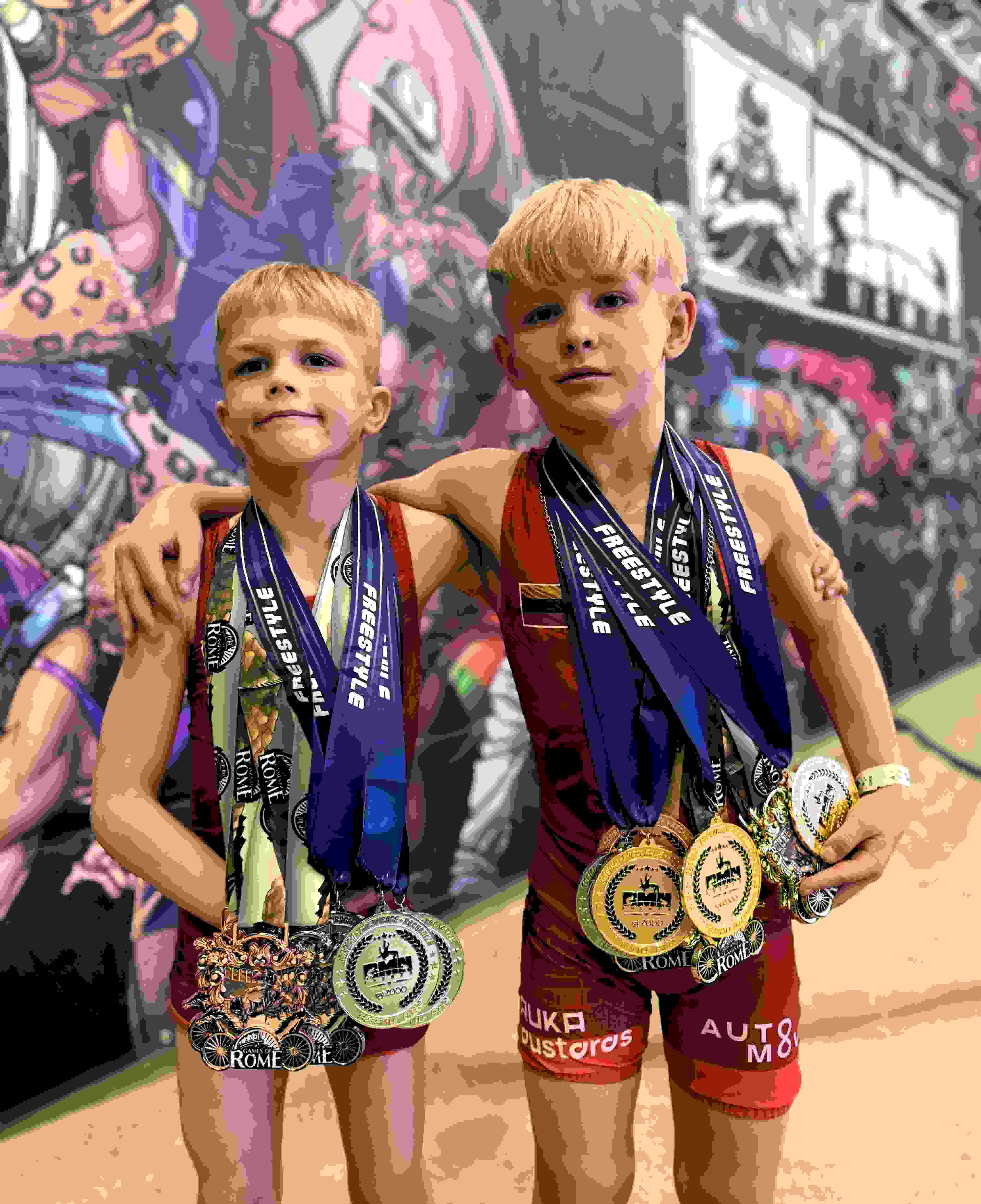
To enhance their sons' grappling skills, Eljotas Zaremba, age 8 and 70 lbs., and Majus Vaiciulis Jr., age 7 and 54 lbs., travel with their parents to the USA to train and compete.
Bill X. Barron
|
Oct 03, 2026
|

0 like
Lithuanian Youth Traverse Continents Seeking Mastery
By Bill X. Barron
Lithuanians Aurimas Zaremba and Majus Vaiciulis Sr. are deeply connected to their country’s wrestling heritage. To enhance their sons' grappling skills, Eljotas Zaremba, age 8 and weighing 70 lbs., and Majus Vaiciulis Jr., age 7 and weighing 54 lbs., travel with their parents to the United States each year to train and compete for 4 to 6 weeks.
Lithuanian culture has roots that extend back more than 100 centuries and is grounded in the traditions of the Baltic peoples. Antanas Kandratas, known as The Lithuanian Lion, achieved fame in the early 20th century through feats of unusual strength in American circuses.
Wrestling in this Baltic nation has its roots in Lithuania's centuries-old farm-based history. This folk wrestling tradition, called “ristynes,” developed as rolling and throwing matches in which shepherds challenged one another to test their strength face-to-face.
In this ancient style, grapplers wear robes and attempt to pin the shoulders three times, using only holds above the waist, similar to Greco-Roman and beach wrestling. In recent years, it has resurfaced, highlighted by ristynes national symposiums and championships.
Despite this tradition, Aurimas believes that a complete wrestler must master all styles, including Jiu-Jitsu. “Freestyle and Greco emphasize active engagement over passivity, primarily on the feet. In folkstyle, you have to be a master of the mat, using your hands to establish control. Combining these skills with martial arts prepares a wrestler for the fight.”
This year, the families’ wrestling journey began in Denver this March at the RMN Games of Rome Championships, where each boy competed in multiple folkstyle and freestyle brackets.
In the 8U, 9U, and 10U divisions at 69-74 lbs., Zaremba brought home six 1st-place and two 3rd-place medals. Competing in 7U, 8U, and 10U at weights 53-62, teammate Vaiciulis earned four 2nd-place and one 3rd-place awards as well as a 5th-place finish.
Through coming to the West Coast to seek competitive opportunities, the Lithuanians discovered the Aniciete Training Club in Las Vegas. “It’s a once-in-a-lifetime opportunity,” says Aurimas. “Not every kid can travel from Europe to the US. The conflict between Ukraine and Russia has nothing to do with sports, but it has blocked access to Russian training centers.
“These boys don’t know who or where they will be in ten years,” Aurimas adds. “Our role as parents is to find new opportunities for growth.”
ATC is led by the Aniciete brothers, Napoleon and Alex, each a 3-time Nevada state champion and high school All-American. They are also coached by Valyen Rauser, a three-time Montana state champion and two-time Fargo champion, and by Antonio Jauregui, a Nevada state champion.
Coach Val emphasizes: “We seek kids who genuinely want to be here and are willing to work hard. Our teachings are straightforward; we concentrate on the essential skills needed to succeed as wrestlers and in life. We take pride in fostering a strong family culture that welcomes those outside our club to jointly train and openly share techniques.”
Over the past five years, ATC has grown from the coaches’ three kids in a garage to a facility used by both the club and top-level athletes training from across the country. The club accepts children ages 4 to 5 and up, across all ages and skill levels, and recently began training high school graduates who return to coach.
“Relationships with the kid and the family make all the difference,” states Napoleon. “To be successful, you need buy-in from everyone involved in a process and on the journey. I remind wrestlers of my own experience.
“Val and I first met at age 9 when we competed in the same bracket at Reno Worlds. He was from Montana, and I lived in Nevada. Later, we also wrestled each other in freestyle. Then we were college roommates and teammates at Utah Valley University. Now, we are coaching and leading our own club here in Las Vegas.
“Our club prioritizes RMN Events for exposure and growth. RMN stands out by offering exclusive awards and distinctive gear, while also offering affordable access to top-tier, diverse multi-state competitions on the West Coast. Our kids and parents enjoy D-Day in San Diego.”
In 2026, former ATC wrestlers were represented at all levels of the collegiate national championships, including NCAA Divisions 1, 2, and 3, NJCAA, and Women's NCAA.
Four-time Nevada girls state champion Emma Albanese, an ATC alumnus competing for Southeast Community College in Nebraska, was named 2026 NJCAA Freshman of the Year after capturing the 117 lb. title, outscoring opponents 53-2 on the season, and leading SCC to a runner-up team finish.
Anthony Aniciete, another ATC wrestler, is a two-time Nevada state champion, a two-time NHSCA national finalist, and a four-time high school All-American. Now a junior at Tiffin University in Ohio, he advanced to the 2026 NCAA Division 2 finals at 125 pounds.
Lithuania may be known for developing NBA-caliber athletes such as Arvydas Sabonis and Zydrunas Ilgauskas. But the country also maintains a long-standing tradition of Greco-Roman wrestling, producing Olympians including Mindaugas Mizgaitis, a 2008 Super-Heavyweight silver medalist, and Aleksandras Kazakevicius, who earned bronze in 2012.
Napoleon characterizes the Lithuanian style as distinctly European, highlighting high-repetition, position-specific exercises, throws, bodyweight drills, bands, dummies, mobility work, and assertive attacking skills, in contrast to the U.S. focus on conditioning and weight training, and on wrestling measured by control rather than exposure.
“Eljotas and Majus are technically proficient at a younger age than the typical American wrestler,” cites Coach Nap. “They are also incredibly disciplined, spending hours in the gym before and after practice, drilling arm throws and lifts 200-300 times in a row.
“At any level, but especially for 8-year-olds, their throws are impressive. They are highly coachable, eager to learn, and passionate about wrestling. Wonderful kids from great families.”
Val shares his insights. “In a match, Eljotas and Majus rely on fundamentals like proper footwork instead of flashy moves. They know when to make a throw, how to execute the technique, and what it feels like to get it right.
“The biggest takeaway is that they are unafraid to go all out. We all know wrestlers who are afraid to lose. These kids are wrestling to score and win, period, whether it is with a throw or a step-over. If they lose, their focus is on what they need to work on through repeated drilling.”
“Wrestling is the most challenging sport of all,” states Aurimas. “We strive to teach our children life skills and success at every level of wrestling by fostering flexibility, enhancing speed, and strengthening balance.
“Finding a way to win and to achieve balance prepares them for life. They learn how to deal with problems, find solutions, and know they can work their way through difficulties.”

Start a live chat with our support team for quick assistance.